Drowning on a Guarded Beach … WHY?
Every professional lifeguard knows the weight of sitting in the stand. The sun is hot, the crowd is loud, and the ocean is a dynamic, shifting environment. To the untrained eye, a guarded beach looks entirely safe. But experienced open-water rescuers know a sobering truth: drownings can happen even when a lifeguard is on duty. To understand why these tragedies occur—and how to prevent them—the lifesaving community relies on a vital framework known as the RID Factor.
Originally developed to analyze lifeguarding failures, RID breaks down the three primary reasons a drowning can happen on a guarded watch: Recognition, Intrusion, and Distraction.
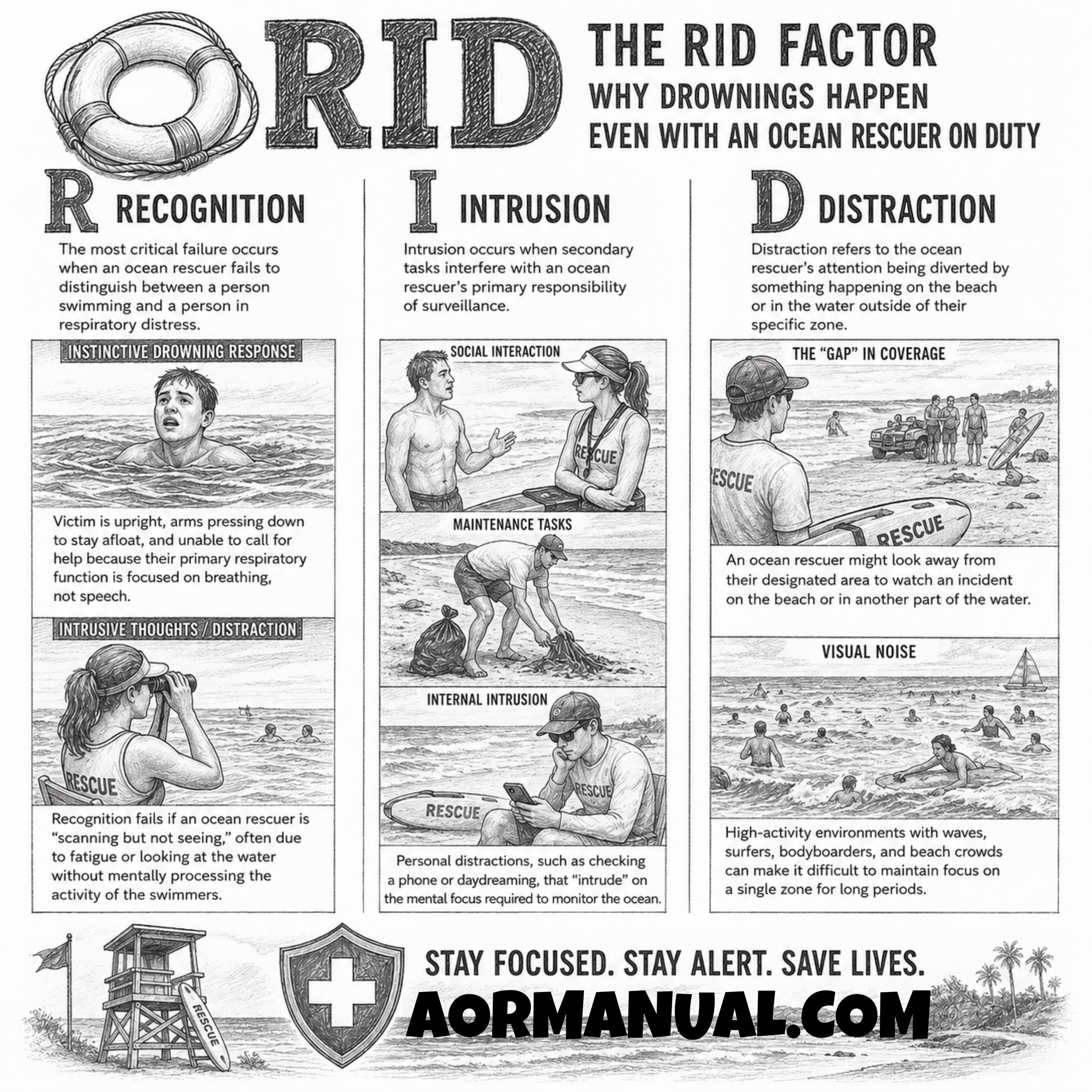
The RID Factor
Why drownings happen even with an ocean rescuer on duty.
1. Recognition: The Failure to See
The "R" in RID stands for a failure of Recognition. It occurs when a lifeguard is looking at the water but fails to distinguish between a regular swimmer and a person in respiratory distress.
True drowning doesn't look like the splashing, waving, and yelling we see in Hollywood movies. Instead, it triggers the Instinctive Drowning Response:
The victim is upright in the water, moving their arms laterally as if pressing down on a tabletop just to keep their mouth above water.
They cannot call for help because their primary respiratory function is focused on gasping for air, not speech.
Recognition can also fail due to a phenomenon called "scanning but not seeing." When fatigue sets in, a guard’s eyes may sweep across the surf zone, but their brain stops mentally processing the activity of the swimmers.
2. Intrusion: Secondary Tasks Creep In
Intrusion happens when non-surveillance duties interfere with a lifeguard’s primary responsibility. When you are on the stand, your only job is the water. Intrusion breaks that focus in three ways:
Social Interaction: A beachgoer stops by the stand to ask for directions or chat, pulling the guard's focus away from a rip current.
Maintenance Tasks: Cleaning up the area around the stand, adjusting equipment, or dealing with trash while actively on surveillance duty.
Internal Intrusion: Personal distractions, daydreaming, or looking down to check a phone.
In the seconds it takes to answer a quick question or check a screen, an ocean swimmer can slide beneath the surface.
3. Distraction: The Pull of Visual Noise
Distraction refers to a lifeguard's attention being diverted by events happening outside their specific zone of responsibility.
The "Gap" in Coverage: A guard might look away from their designated swimming zone to watch an interesting incident happening on the boardwalk, a vehicle driving on the beach, or an active rescue occurring in a neighboring territory.
Visual Noise: High-activity environments filled with crashing waves, surfers, bodyboarders, and dense crowds create a chaotic canvas. This constant motion makes it incredibly difficult to maintain a sharp, continuous focus on a single zone for long periods.
Holding the Line
The ocean is unforgiving, and the margin for error is razor-thin. Statistics show that the presence of professional lifeguards dramatically alters survival rates, but that safety record is only as strong as the guard currently sitting in the chair.
Overcoming the RID factor requires rigorous training, strict scanning discipline, regular stand rotations to fight fatigue, and an unyielding professional mindset.
When you are on duty, remember the stakes. Stay focused. Stay alert. Save lives.