The Science of Missing Children: Behavioral Patterns on the Beach
When a frantic parent runs up to a lifeguard stand shouting that their child is missing, time stops. For parents, the immediate, gut-wrenching terror is that their child ran straight into the crashing surf.

However, behavioral search and rescue (SAR) data tells a vastly different, reassuring story.
Understanding the behavioral science behind lost children transforms search management from a chaotic guessing game into a targeted, highly successful operations model—offering crucial reassurance to panicked families in the opening minutes of a report.
Traditional Wilderness SAR vs. The Beach Environment
In traditional Search and Rescue (SAR)—such as dense forests, parks, or mountainous terrain—missing children often wander off trails, get disoriented by identical-looking trees, or seek shelter under rock overhangs or thick brush.
On a crowded ocean beach, human psychology interacts with a unique set of geographic and environmental vectors:
The Linear Dynamic: Unlike a 360-degree wilderness search grid, beaches operate primarily on a two-dimensional linear axis: the water line (west/east or north/south along the shore) and the dune line.
Visual Monotony: To a young child (typically ages 3–7), every towel, umbrella, and windbreak looks identical from a low vantage point. Once a child steps 20 yards away from their family’s setup, their visual landmarks disappear.
Noise and Sensory Overload: The continuous roar of crashing surf and ambient crowd noise masks parental calls, causing lost children to rely almost entirely on visual direction rather than auditory cues.
Behavioral Patterns: Why Kids Walk With the Wind (And Avoid the Water)
Search theory relies on lost person behavior profiling (pioneered by researchers like Robert Koester in the Lost Person Behaviordatabase). When applied to coastal environments, several consistent behavioral patterns emerge:
Non-Autistic Children Rarely Venture Into the Surf Alone
One of the most vital facts to communicate immediately to a panicked parent is that neurotypical young children almost never wander deep into the ocean when lost.
The Fear Vector: Cold, crashing waves and deep water present a powerful visual barrier. When a child realizes they are separated from their parents, their primary instinct shifts to self-preservation and comfort, turning them away from the intimidating surf toward the dry sand.
Paralleling the Water: Instead of entering the ocean, children almost universally walk parallel to the shoreline along the hard-packed wet sand where walking is easiest.
2. The Wind and Sun Vector
Children consistently take the path of least resistance:
Walking Downwind: Young children overwhelmingly walk with the wind at their back. Walking into a stiff ocean breeze means sand in their eyes, stinging faces, and heavy physical resistance.
Sun Angle: Kids tend to walk away from the glare of the blinding sun, favoring directions where visual navigation is comfortable.
3. The "Looking Up" Phenomenon
As children walk downwind, they actively seek visual familiarity. They look for high-contrast objects, colorful umbrellas, landmark lifeguard towers, or groups of adults that superficially resemble their family. Guard may easily spot this type of lost child “looking up” and wandering aimlessly compared to others socializing in a group.
The Crucial Exception:
Children on the Autism Spectrum
While neurotypical children generally avoid the water when disoriented, behavioral SAR research highlights a critical exception: children diagnosed with Autism Spectrum Disorder (ASD), particularly those prone to wandering or elopement may be drawn to the water.
Why Water Is a High-Risk Magnet for ASD Elopement
Sensory Seeking: Research in wandering behaviors indicates that a high percentage of children with ASD who elope are strongly drawn to bodies of water due to the sensory input—the shimmering light, reflection, movement, and acoustic repetition of waves.
Absence of Risk Perception: Children on the spectrum may lack the natural apprehension toward crashing waves or strong currents that stops other children at the water's edge.
Communication Barriers: A lost child on the spectrum may not respond when their name is called by beach patrols or megaphones and may actively seek out quiet areas under pier structures or high-dune corridors to escape sensory overload.
Operational Takeaway: When taking a lost child report, beach safety personnel must immediately ask parents: "Is your child on the autism spectrum or non-verbal?" If the answer is yes, search protocols immediately prioritize an immediate, high-density water-line sweep and possible multi-guard water entry. Be aware of this difference.
How Lifeguards Put the Science to Work
Immediate Orientation Check: Lifeguard dispatch checks the current wind velocity and direction.
Downwind Sweep First: Secondary units are dispatched downwind along the main tide line, where speed and probability intersect.
Primary Point-of-Last-Seen (PLS) Anchor: A stationary guard or parent remains anchored directly at the PLS (the family umbrella), as wandering children frequently backtrack once they realize they are lost.
Reassure the Parents: The Math and Statistics Favor a Quick Reunion
When parents report a missing child, shock and catastrophe-thinking take hold instantly. Part of advanced ocean rescue leadership is using empirical statistics to ground and calm the family while field units deploy.
Understanding that lost children follow predictable behavioral physics transforms search operations from a desperate scramble into an efficient, evidence-based science—bringing kids back to their families quickly and safely.
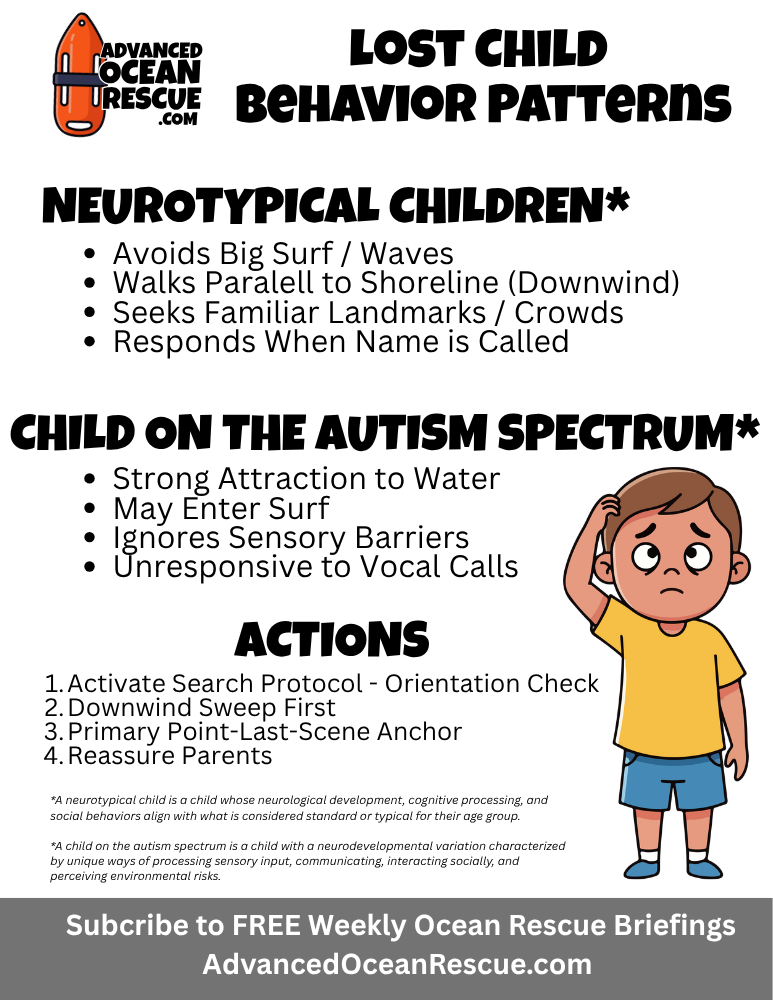
Download the Poster
Click the image to the left and download a printable poster for your bulletin board.