When the Victim Fights Back: Navigating CPR-Induced Consciousness
Picture this: You are on the beach when you witness a patron going down. They were previously conscious, but within moments, they slip into cardiac arrest. You immediately activate the EMS protocol for your organization, do your primary checks and initiate high-quality cardiopulmonary resuscitation (CPR) following American Heart Association (AHA) protocols including the request for an AED.
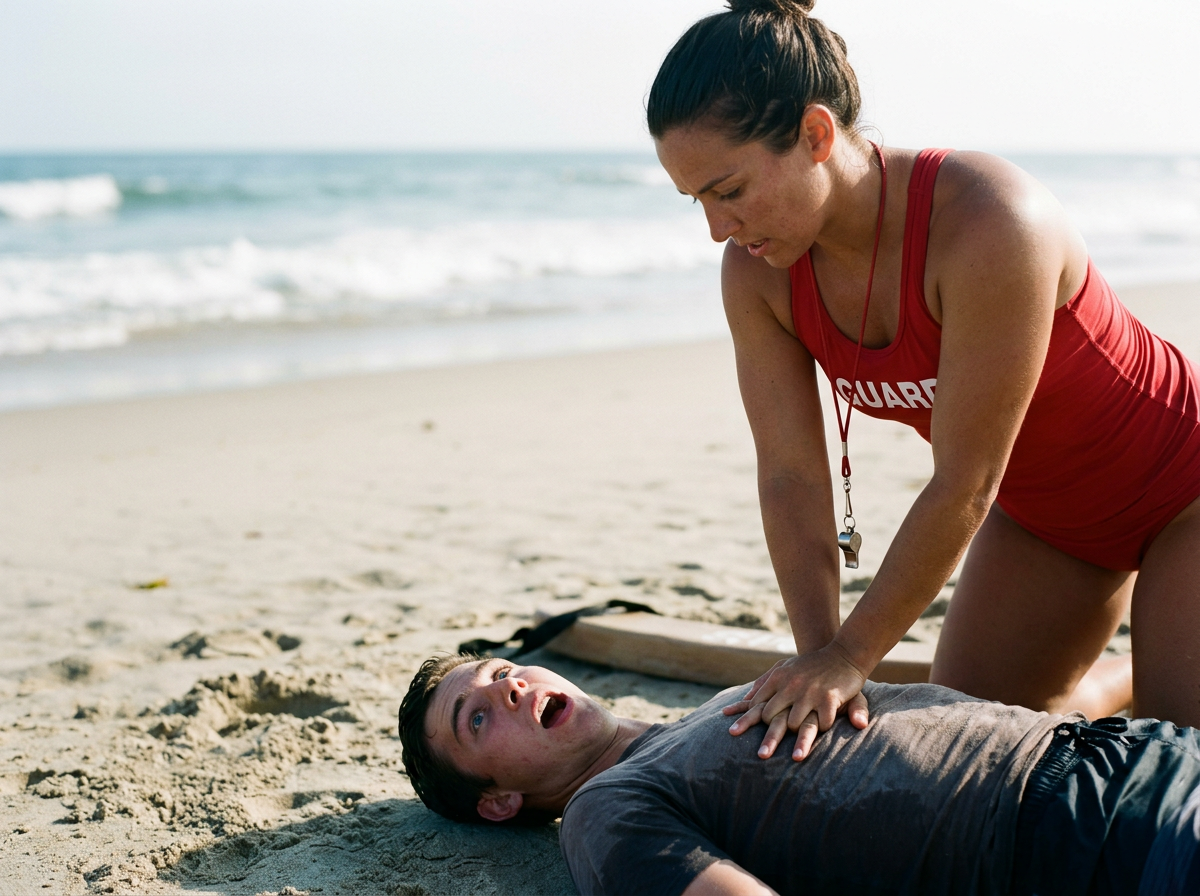
Then, the situation takes a deeply unnerving turn.
As you push hard and fast, the patient suddenly gasps, opens their eyes, starts thrashing, and aggressively tries to push you away or fight off your compressions. They look right at you with panic and agitation.
Your instincts scream that something is wrong, so you pause compressions, check for a pulse, and prep the AED. No pulse. The rhythm check confirms they are still in cardiac arrest. Yet, the moment you resume compressions, the fighting and conscious posturing return.
Welcome to one of the most psychologically jarring and complex scenarios a lifeguard or EMS first responder can face: CPR-Induced Consciousness (CPRIC).
What is CPR-Induced Consciousness ?
CPR-Induced Consciousness occurs when a pulseless patient undergoing active resuscitation exhibits signs of awareness—such as purposeful limb movements, combativeness, speaking, or opening their eyes.
The Paradoxical Science
It feels entirely counterintuitive. How can someone be awake if their heart isn't beating?
Cerebral Perfusion: High-quality chest compressions artificially circulate a small amount of blood (and oxygen) to the brain.
The Threshold Effect: In some individuals—frequently younger, physically fit victims like ocean recreators, surfers, or athletes—that small volume of artificial blood flow is just enough to cross the cerebral ischemic threshold, waking up the brain's electrical activity.
The Catch: While the brain is briefly waking up, the heart muscle itself has not achieved a Return of Spontaneous Circulation (ROSC). The mechanical squeezing of your hands is what is keeping them "conscious," even though they remain clinically in cardiac arrest.
Research indicates that CPRIC is not actually a rare anomaly; it is an increasingly recognized phenomenon tied directly to the push for early, high-quality chest compressions and mechanical resuscitation devices. Statistically, data shows that CPRIC is actually associated with improved overall survival and neurologically intact recovery because it proves the brain is receiving perfusion. However, for the rescuer on the scene, it feels like chaos.
The Rescuer’s Dilemma:
Navigating the Chaos
When a pulseless patient starts fighting your compressions, it triggers major operational roadblocks:
Rescuer Hesitation & Interruption: Rescuers naturally back off when a patient looks at them and fights back, which dangerously pauses life-saving chest compressions.
Delayed Defibrillation: Precious seconds are wasted trying to figure out if the patient has magically recovered, delaying vital AED analysis and shock delivery.
Severe Psychological Stress: It is deeply unsettling for professional lifeguards and first responders to feel like they are physically hurting an alert, combative person who is technically dead.
Protocols and Best Practices for OCEAN RESCUERS
Managing CPRIC requires a shift in mindset: You are not hurting a conscious person; your compressions are what are keeping their brain alive.
1. Systematic Verification (Never Guess)
When a patient demonstrates signs of consciousness during a code:
Do not stop abruptly without a plan.
Quickly coordinate with the other team members responding to perform a structured pulse and rhythm check via the AED or manual check.
If there is no pulse and a shockable/non-shockable arrest rhythm persists, immediately resume high-quality CPR. Do not let the visual feedback deter you from the algorithm.
2. Physical Management and Reassurance
Team Communication: Assign a designated rescuer to speak directly to the patient. Calmly, firmly, and repeatedly reassure them: "I know it hurts, I'm right here, we've got you, keep breathing." Voice tone matters immensely.
Controlled Restraint: Because combative movements can displace hands, interrupt cadence, or pull on equipment, auxiliary rescuers MAY need to gently restrain the patient's arms or torso to maintain effective, continuous chest compressions without injuring the patient or the team.
3. Advanced/EMS Transition: The Role of Chemical Sedation
For professional responders and advanced life support (ALS/EMS) units arriving on scene, managing CPRIC often requires pharmaceutical intervention.
Ketamine Protocols: Many modern pre-hospital EMS protocols authorize the administration of fast-acting dissociative agents like Ketamine (often via IV/IO or IM routes) when CPRIC causes violent agitation that prevents life-saving care. Ketamine provides dissociation and analgesia while maintaining hemodynamic stability (minimizing the risk of crashing blood pressure further). Obviously this is reserved for the Paramedic and Advanced Medical teams.
Avoiding Hypovolemic Pitfalls: Older protocols sometimes relied heavily on opioids or benzodiazepines, but modern clinical review advises caution with agents that can induce severe hypotension during a cardiac arrest context.
Key Takeaways for the Front Line
It’s a Sign of Good CPR: Recognize that an awake, fighting patient under CPR means your compression fraction and depth are hitting the mark.
Stick to the Algorithm: Confirm the lack of a true pulse through standard checks, but do not let cognitive dissonance halt the code.
Prepare the Team: Brief your ocean rescue crews during training drills about CPRIC. Knowing it can and will happen prevents panic, protects compression quality, and keeps the focus where it belongs—surviving the crisis.
In the high-stakes environment of ocean rescue, chaos is guaranteed when a pulseless victim suddenly wakes up and fights your compressions, but panic is entirely optional. When you understand the physiological paradox of CPR-Induced Consciousness, the alarming sight of a combative patient transforms from a terrifying unknown into an anticipated clinical marker of high-quality perfusion. The difference between freezing on the sand and executing a seamless resuscitation comes down to preparation.
Have a plan, train your team to execute it without hesitation, and stick to the protocol when the pressure peaks.