Rapid Response & Extrication Protocols for Sand Hole Collapses
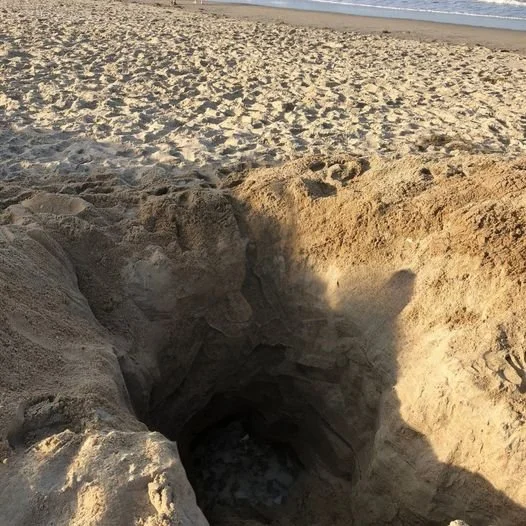
While prevention is important —- understanding the protocol for dealing with a trapped victim in a sand hole collapse is critical.
The Operational Reality: A Zero-Visibility Structural Trap
A sand hole collapse is not a routine beach dig-out; it is an immediate, high-mortality zero-visibility structural trap. The moment dry, granular sand collapses over a buried patron, the clock begins ticking against rapid mechanical asphyxia. While prevention campaigns remain our first line of defense, professional ocean rescue agencies must maintain an uncompromising, step-by-step tactical protocol for the second a bystander alerts guards that a patron is buried under the sand.
The Physics of the Hazard: Angle of Repose & Compression Traps
Angle of Repose: Dry beach sand maintains a natural angle of repose between 30° and 34°. The angle of repose in sand is the steepest slope angle relative to a horizontal base at which loose sand piles remain stable without sliding. When an excavation pit collapses, surrounding sand continually flows down into the void at this angle.
Mass & Compression: Dry sand weighs approximately 90 to 100 lbs per cubic foot (damp sand exceeds 120 lbs/cu.ft.). A chest buried under just two feet of sand bears hundreds of pounds of continuous compression, preventing mechanical chest expansion (traumatic asphyxia) and causing rapid suffocation within minutes.
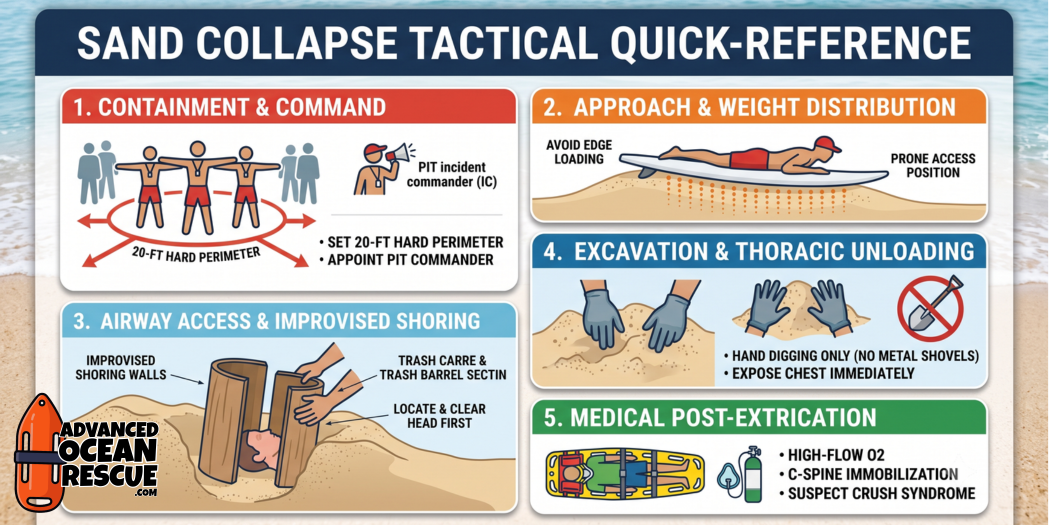
A 5-Phase Tactical Response Approach for Sand Hole Collapses
Immediate Tactical Response Protocol (5-Phase Breakdown)
Phase 1: Scene Command & Crowd Containment (0–60 Seconds)
Dispatch Heavy Rescue Immediately: The moment a collapse is reported, initiate an immediate full-beach alert and request dispatch of urban search and rescue (USAR) / heavy rescue units equipped with structural shoring equipment, high-flow medical oxygen, and suction tools. Activating the organization’s EMS protocol is critical in the first minute. Most beach patrol organizations do not have this type of equipment at the ready. Alerting EMS of the situation and needing these items will expedite the rescue.
Enforce a Hard 20-Foot Perimeter: Well-meaning bystanders and distraught relatives running toward the hole represent an immediate fatal hazard. Foot pressure within the perimeter transfers thousands of pounds of force directly into the subterranean void, triggering secondary wall collapses. Arriving guards must immediately lock arms or deploy rescue cans/buoys to force the crowd back at least 20 feet from the hole's edge.
Appoint a Pit Incident Commander (IC): One guard must remain strictly outside the pit to manage perimeter discipline, maintain radio communications, and direct incoming advanced EMS and gear. Guards inside the pit must focus 100% of their kinetic energy on the victim.
Phase 2: Tactical Approach & Weight Distribution
Eliminate Edge Loading: Rescuers must never stand upright on the lip of the hole. Standing upright focuses body weight into a concentrated point, forcing surrounding sand directly down onto the victim's chest or face.
Prone Access Position: Rescuers must approach the excavation site in a fully prone (belly) position. Lay rescue boards, bodyboards, or skimboards flat across the perimeter edges of the hole to bridge body weight over a wide surface area before reaching inward.
Phase 3: Airway Access & Improvised Shoring
Locate & Clear the Head First: Do not attempt to dig out limbs or body parts until the head and airway are completely exposed and cleared of sand. Sweep sand out of the mouth and nostrils immediately using fingers.
Deploy Improvised Shoring Walls: Unconsolidated sand slides back into the pit as fast as it is removed. Rescuers must establish physical barriers around the victim's head:
Hard Equipment Shoring: Drive rescue boards, skimboards, bodyboards, wooden walkway planks, or large plastic trash cans (bottom cut out) vertically into the sand surrounding the victim's upper torso to lock back the sliding sand walls. Grab ANYTHING you can get your hands on that will provide this type of support.
Human Shoring Chain: Position secondary rescuers in a circle around the primary diggers, digging away outer sand to flatten the pit's outer slope and reduce the angle of repose.
Phase 4: Excavation & Chest Unloading
Mandate Hand & Soft Digging Only: Once rescuers are working within 2 feet of the estimated victim depth, ban all metal shovels. Sharp shovel blades inflict catastrophic head, neck, and ocular trauma on hidden victims. Use hands, plastic buckets, or rescue torpedo buoys as scoops.
Relief of Thoracic Compression: Expose the victim's chest cavity as fast as humanly possible. Even with an open airway, a victim buried under heavy sand cannot expand their diaphragm. Clearing sand from the sternum and ribs restores mechanical ventilation.
Overcoming Friction & Suction: Never attempt a forced vertical pull on the head, neck, or arms of a partially buried victim. Sand exerts massive friction and suction forces on lower limbs. Dig completely around the hips and thighs before executing a lift to avoid spinal column traction or shoulder disarticulation.
Phase 5: Post-Extrication Medical Considerations
High-Flow Oxygen & Airway Monitoring: Administer high-flow supplemental oxygen via non-rebreather mask immediately upon head exposure. Continuous suction must be ready for sand particulate in the upper airway.
Suspect Crush Syndrome & Metabolic Shock: Prolonged sand compression on large muscle groups (legs, pelvis) can cause localized ischemia. Upon pressure release, toxic metabolites (potassium, myoglobin) can flood the cardiovascular system, leading to cardiac arrest or renal failure. Keep the patient supine and transfer immediately to advanced paramedic care.
Cervical Spine Immobilization: If the collapse was initiated by a fall, jump, or structural collapse into a deep hole, maintain strict cervical spine alignment during final extrication onto a hard backboard.
WHEN PREVENTION FALLS SHORT
While often perceived as benign beach play, a deep sand hole is a high-consequence structural trap waiting for a single, small collapse to become a crisis. By applying the advanced operational protocols outlined above—focusing on rigorous containment, critical weight distribution, and immediate improvised shoring—lifeguards can shift the odds in favor of the victim during those initial, vital minutes of an extraction. Successful rescue from these severe incidents requires more than just goodwill; it demands technical discipline, specialized training, and a fast, coordinated response that recognizes the intense and dangerous physics of the sand.